Ana sayfa › MukavemetStrength of Materials › Basma YayıCompression Spring
Baskı yayı
Compression spring
Uç tipini seçin. Yay sabiti, Wahl faktörü ve emniyetli strok yazdıkça güncellenir.
Pick the end type. Spring rate, Wahl factor and safe stroke update as you type.
Reklam
Baskı yayı neden sadece yay sabitinden ibaret değildir?
Baskı yayı, helisel sarılmış bir telin eksen boyunca ezilerek enerji depolamasıdır. Seçimde yalnız yay sabitine bakmak yetmez. Uç geometrisi sıkışık boyu değiştirir. Malzemenin kayma gerilmesi de, tel birbirine değmeden önce yayın kalıcı ezilmesine yol açabilir. Kullanılacak en uzun strok, bu iki sınırdan küçük olanıdır.
Temel formüller
d tel çapı (mm), OD dış çap (mm), FL serbest boy (mm), n aktif sarım, G kayma modülü (N/mm²), Su minimum çekme dayanımıdır (N/mm²).
Ortalama çap, yayın merkez dairesidir:
Dm = OD − d
Yay indisi üretilebilirliği gösterir. 4 ile 12 arası rahat sarılır.
C =Dmd
Tel kıvrıldığı için iç yüzde gerilme yığılır. Wahl faktörü bunu düzeltir:
W =4C − 14C − 4+ 0,615 / C
Yay çeliğinde emniyetli kayma gerilmesi, çekme dayanımının %47’si alınır:
τ = Su · 0,47
Yayı 1 mm ezmek için gereken kuvvet yay sabitidir:
k =G · d⁴8 · n · Dm³
Kalıcı şekil değişimine kadar taşınabilecek teorik kuvvet:
Flimit =τ · π · d³8 · W · Dm
Dört uç tipi
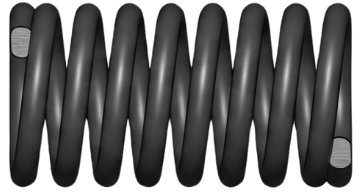
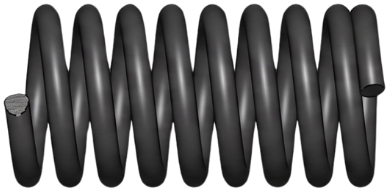
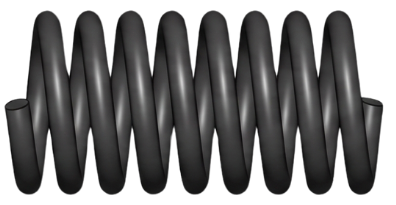
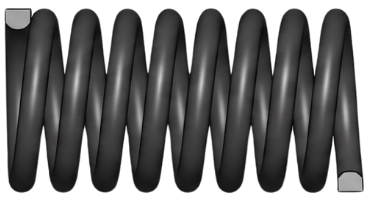
Kapalı ve taşlanmışKapalı, taşlanmamışAçık uçÇift kapalı uç
Kapalı ve taşlanmış uç, basma yüzeyine dik oturur. Endüstride en sık kullanılan tiptir. Toplam sarım ve sıkışık boy:
nt = n + 2 Ls = nt · d
Kapalı ama taşlanmamış uç daha ucuzdur. Eksen hassasiyeti daha düşüktür. Sıkışık boy bir tel payı daha uzundur:
nt = n + 2 Ls = (nt + 1) · d
Açık uç, kılavuz mil ya da kovan içinde yer kazandırır. Aktif sarım toplam sarıma eşittir:
nt = n Ls = (nt + 1) · d
Çift kapalı uç, titreşimli yerde yayın dik durmasını ister. İki uçta da fazladan kapalı sarım vardır:
nt = n + 4 Ls = (nt + 1) · d
Reklam
Hangi strok emniyetlidir?
Fiziksel yol, serbest boy ile sıkışık boy arasındaki boşluktur: FL − Ls. Tel tele değince yay daha fazla ezilmez. Malzeme yolu, sınır kuvvetin yay sabitine bölümüdür: Flimit / k. Bu yol aşılırsa yay kalıcı kısalır. Emniyetli maksimum yol bu iki değerden küçük olanıdır. O yoldaki kuvvet Fmax = k · yol şeklinde bulunur.
Bu hesap ön değerlendirme amaçlıdır. Nihai tasarım için yetkili bir mühendisin kontrolü gerekir.
A compression spring is more than its rate
A compression spring stores energy as a helical wire is squeezed along its axis. Looking only at the spring rate is not enough. The end geometry changes the solid height. The shear strength of the wire can also take a permanent set before the coils touch. The longest stroke you can use is the smaller of those two limits.
The basic formulas
d is the wire diameter (mm), OD the outside diameter (mm), FL the free length (mm), n the active coils, G the shear modulus (N/mm²) and Su the minimum tensile strength (N/mm²).
The mean diameter is the centre circle of the spring:
Dm = OD − d
The spring index says how workable the coil is. Between 4 and 12 it winds comfortably.
C =Dmd
Because the wire is curved, stress piles up on the inside. The Wahl factor corrects for that:
W =4C − 14C − 4+ 0.615 / C
For spring steel the allowable shear stress is taken as 47 percent of the tensile strength:
τ = Su · 0.47
The spring rate is the force needed to deflect the spring by 1 mm:
k =G · d⁴8 · n · Dm³
The theoretical force before a permanent set:
Flimit =τ · π · d³8 · W · Dm
Four end types
Closed and groundClosed, not groundOpen endsDouble closed
Closed and ground ends sit square on the seat. This is the usual industrial type. Total coils and solid height:
nt = n + 2 Ls = nt · d
Closed ends that are not ground cost less and are less square. The solid height is one wire longer:
nt = n + 2 Ls = (nt + 1) · d
Open ends save space on a guide rod or inside a housing. Total coils equal the active coils:
nt = n Ls = (nt + 1) · d
Double closed ends keep the spring square where there is vibration. Both ends carry extra closed coils:
nt = n + 4 Ls = (nt + 1) · d
Reklam
Which stroke is safe?
The physical travel is the gap between free length and solid height: FL − Ls. Once coil touches coil, the spring cannot deflect further. The material travel is the limit force divided by the rate: Flimit / k. Past that, the spring takes a permanent set. The safe maximum travel is the smaller of the two. The force at that travel is Fmax = k · travel.
This calculation is for preliminary design. A qualified engineer should check the final design.