Ana sayfa › Akışkan MekaniğiFluid Mechanics › VenturimetreVenturi Meter
Venturimetre Hesabı
Venturi meter
Giriş ve boğaz alanı ile iki basınçtan hacimsel debi. Sonuç m³/h.
Volumetric flow from the inlet area, the throat area and the two pressures. The result is in m³/h.
Reklam
Venturimetre ne ölçer?
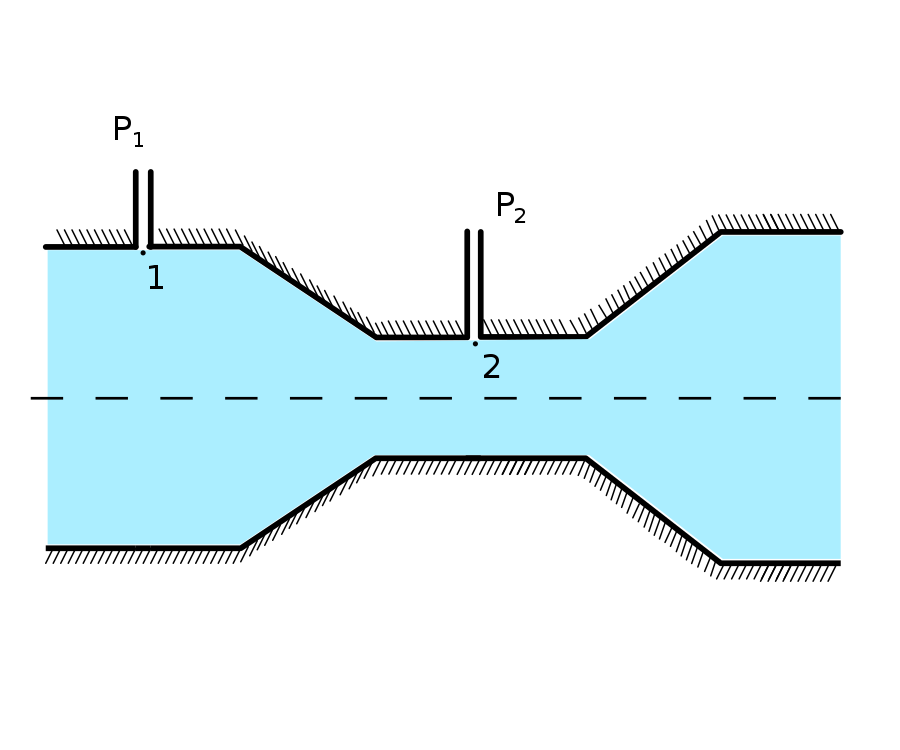
Venturimetre, içinden geçen akışkanın debisini ölçen bir tüptür. İki ucu açıktır ve kesiti ortaya doğru daralır. Daralan yerde hız artar, basınç düşer. Geniş kesit ile boğaz arasındaki bu basınç farkı, debisini verir.
Geniş kesitte basınç P1, boğazda P2. Boğaz daha hızlı olduğu için P2 daha düşüktür.
Elinizde çap varsa alanı ayrıca bulun: A = π · d² / 4. Bu sayfa alanı doğrudan ister.
Debi
Bernoulli ve süreklilik, kayıpsız bir tüp için debiyi şöyle bağlar. Sonuç önce m³/s çıkar, sonra saate çevrilir:
A1 giriş alanı, A2 boğaz alanıdır. Boğaz girişten küçük olmalıdır. P1, P2’den büyük olmalıdır; aksi halde kökün içi eksi olur ve debi tanımsızdır. Katsayı olarak bir boşaltma katsayısı yoktur: bu, ideal tüpün debisidir.
Reklam
Örnek
A1 = 0,01 m², A2 = 0,0025 m², yoğunluk 1,2 kg/m³, P1 = 100.000 Pa ve P2 = 98.000 Pa olsun. Fark 2.000 Pa’dır. Debi 536,656 m³/h çıkar.
Bu hesap ön değerlendirme amaçlıdır. Gerçek tüpte sürtünme ve akışın daralması debiyi düşürür. Ölçülen debi için bir boşaltma katsayısı ayrıca konur. Nihai kullanımda yetkili bir mühendisin kontrolü gerekir.
What a venturi meter measures
A venturi meter is a tube that measures the flow through it. Both ends are open and the section narrows toward the middle. Speed rises in the throat and pressure falls. That pressure difference, between the wide section and the throat, gives the flow rate.
Pressure is P1 in the wide section and P2 in the throat. The throat is faster, so P2 is lower.
If you have a diameter, find the area first: A = π · d² / 4. This page asks for the area directly.
The flow rate
Bernoulli and continuity tie the flow of a lossless tube like this. The result is in m³/s first, then turned into an hourly rate:
A1 is the inlet area and A2 is the throat. The throat must be smaller than the inlet. P1 must be higher than P2; otherwise the value inside the square root is negative and the flow is undefined. There is no discharge coefficient: this is the flow of an ideal tube.
Reklam
Example
Take A1 = 0.01 m², A2 = 0.0025 m², a density of 1.2 kg/m³, P1 = 100,000 Pa and P2 = 98,000 Pa. The difference is 2,000 Pa. The flow is 536.656 m³/h.
This calculation is for a first look. Friction and the contraction in a real tube reduce the flow. A discharge coefficient is applied separately when the measured flow is needed. A qualified engineer should check the final use.