Ana sayfa › Akışkan MekaniğiFluid Mechanics › Siklon HesabıCyclone Calculator
Siklon Hesabı
Cyclone calculator
Ön tasarım. Boyutsuz basınç düşümü, dönüş sayısı, kalma süresi, basınç kaybı, kesme çapı, güç ve tutulan partikül oranı.
Preliminary design. Dimensionless pressure drop, number of turns, residence time, pressure loss, cut size, power and the share of particles kept.
Reklam
Siklon ne ayırır?
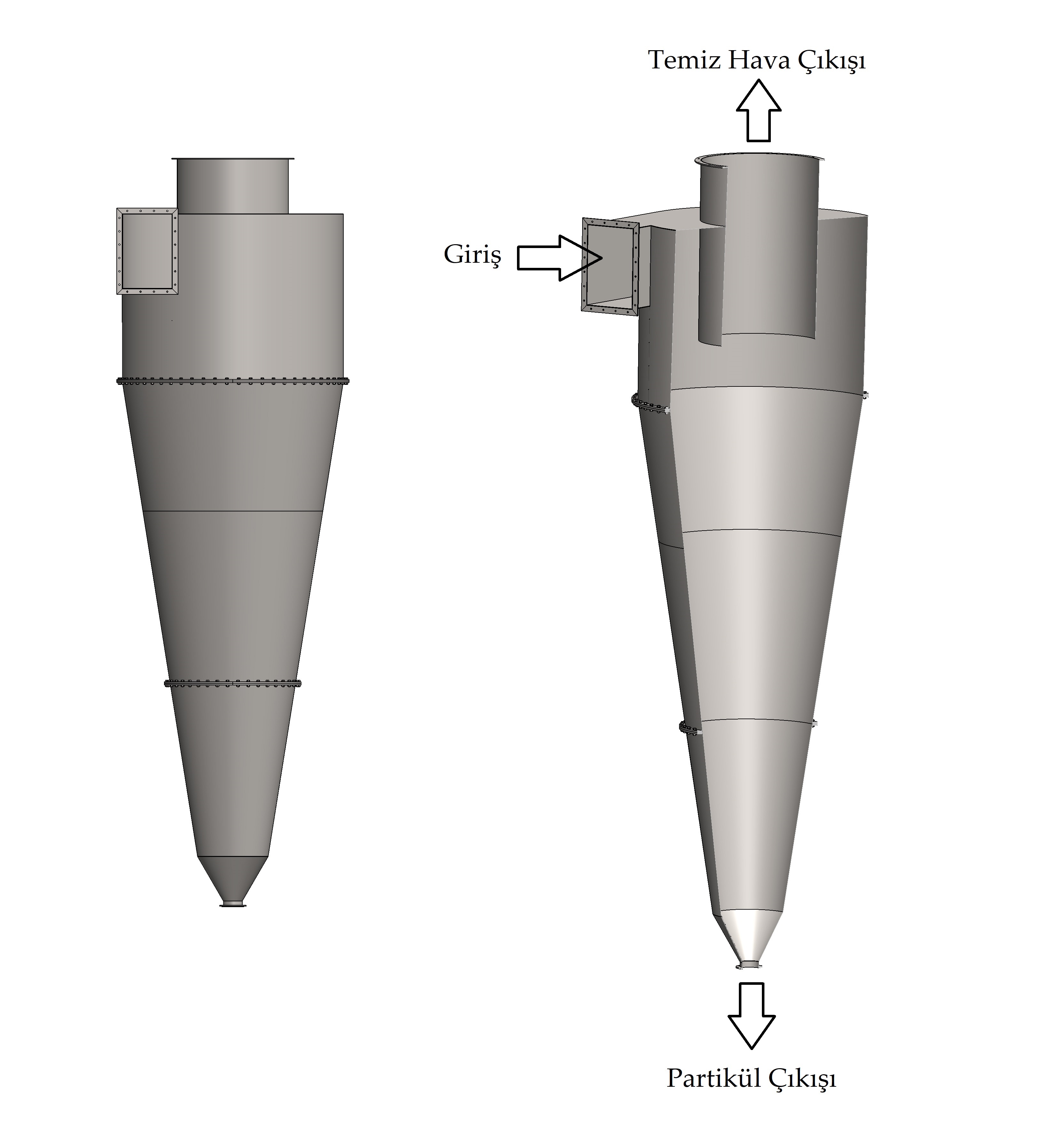
Siklon, gazın içindeki katı partikülü ayıran bir separatördür. Gaz, gövdeye teğet girer ve dönerek aşağı iner. Ağır partikül duvara savrulur, koninin ucundan çıkar. Temizlenen gaz ortadan yukarı çıkar. Performansı iki sayıyla anlatılır: ne kadar toz tuttuğu ve bunu yaparken ne kadar basınç harcadığı.
Gaz yandan girer. Temiz hava üstten, tutulan partikül alttan çıkar.
Aynı gövde yüksek verim için de, yüksek debi için de kurulabilir. Aşağıdaki bağıntılar bir ön hesaptır. Lapple düzenidir. Sahadaki sıcaklık, tozun yapışması ve imalat payı sonucu değiştirir.
Yedi sonuç
Boyutsuz basınç düşümü, girişteki hız yüksekliği cinsindendir:
PYBD = 16 ·a · bDe²
Dönüş sayısı, düz boy ile konik boyun yarısını giriş yüksekliğine böler:
DS = (1 / a) · (h + z / 2)
Gazın içeride kaldığı süre, gövde çevresini dönüş sayısı kadar dolaşmanın aldığı zamandır:
GKS =2 · π · (D / 2) · DSv
Basınç düşümü, boyutsuz değeri havanın hız yüksekliğiyle çarpar:
PD = 0,5 · ρh · v² · PYBD
Kesme çapı, yarısı tutulan partikülün çapıdır. Metre cinsinden çıkar, ekranda mikrona çevrilir. μ, formüle doğrudan girer; birimi Pa·s’tir.
Fanın bu basıncı yenmesi için gereken güç, debiyi saniyeye çevirip basınçla çarpar:
Güç = (Q / 3600) · PD
Girdap uzunluğu S, toplam boy H ve toz çıkış çapı B çizimde durur. Bu yedi bağıntı onları kullanmaz. H, düz boy ile konik boyun toplamı olmalıdır. Değilse hesap durmaz, bir not düşer.
Reklam
Tutulan miktar
Her çap için tutulma olasılığı, kesme çapına göre kurulur. Çaplar mikrondur.
Ti = 1 / ( 1 + (D50 / di)² )
O çapın tutulan payı, olasılığın yüzde miktarla çarpımıdır. Toplam verim bu payların toplamıdır. Yüzdeler 100’e bölünmez. Toplam 100 değilse sonuç yine toplanır ve bir not düşer.
Tutulani = Ti · yüzdei
Verim = Tutulan1 + Tutulan2 + …
Sayfadaki örnek
Debi 144 m³/h, partikül yoğunluğu 2.500 kg/m³, giriş hızı 2 m/s, siklon çapı 0,3 m, giriş 0,2 m × 0,1 m, girdap çapı 0,1 m, düz boy 0,4 m, konik boy 0,2 m. Hava 1,009 kg/m³ ve 0,00002056 Pa·s.
Sonuç
Değer
Boyutsuz basınç düşümü
32
Dönüş sayısı
2,5
Kalma süresi
1,1781 s
Basınç düşümü
64,576 Pa
Kesme çapı
15,3524 μm
Güç
2,583 W
Tutulan partikül
%97,927
Eski sayfadaki formül görseli süreyi 1,18 s, kesme çapını 15,36 μm, gücü 2,58 W ve verimi %97,92 diye yuvarlar. Aynı yedi partikül çapı ve yüzdesi kullanılır: 505 μm %1,4, 288 μm %18,5, 182 μm %27,5, 131 μm %25,8, 109 μm %2,1, 80 μm %18,7, 40 μm %6.
Hava yoğunluğu 1 kg/m³ alınırsa basınç düşümü tam 64 Pa olur. Sayfadaki CFD karşılaştırması bu yuvarlak değeri kullanır: hesap 64 Pa, analiz 57 Pa.
Analizle fark
Farklı boydaki partiküllerin siklon içindeki yolu CFD ve DEM ile de bakılmıştır. Hesap 64 Pa derken analiz 57 Pa bulmuştur. Aradaki fark, ön hesabın duvar sürtünmesini ve gerçek hız dağılımını tek bir katsayıya sıkıştırmasındandır.
Örnek analiz. Renkler hızı, izler partikülün dönerken izlediği yolu gösterir.
Bu hesap ön değerlendirme amaçlıdır. Sıcaklık, tozun nemi, yapışma ve imalat toleransı sonucu değiştirir. Nihai ölçü için yetkili bir mühendisin kontrolü gerekir.
What a cyclone separates
A cyclone is a separator that takes solid particles out of a gas. The gas enters on a tangent and spins downward. Heavy particles are thrown to the wall and leave through the cone. The cleaned gas rises through the centre. Two numbers describe it: how much dust it keeps, and how much pressure that costs.
Gas enters from the side. Clean air leaves at the top and the captured particles leave at the bottom.
The same body can be built for high efficiency or for high flow. The relations below are a preliminary Lapple estimate. Temperature, sticky dust and fabrication allowance all move the result.
The seven results
The dimensionless pressure drop is counted in inlet velocity heads:
ΔH = 16 ·a · bDe²
The number of turns divides the cylinder plus half the cone by the inlet height:
N = (1 / a) · (h + z / 2)
Residence time is how long the gas takes to travel the body circumference once for each turn:
t =2 · π · (D / 2) · Nv
Pressure drop multiplies that head count by the velocity head of the air:
ΔP = 0.5 · ρh · v² · ΔH
Cut size is the diameter that is captured half the time. The formula returns metres; the page shows microns. μ enters the formula directly, in Pa·s.
d50 = √( 9 · μ · b / ( 2 · π · N · v · (ρp − ρh) ) )
The power needed to overcome this pressure turns the flow into cubic metres per second and multiplies:
Power = (Q / 3600) · ΔP
Vortex-finder length S, total length H and dust-outlet diameter B sit on the drawing. These seven relations do not use them. H should be the cylinder plus the cone. If it is not, the calculation still runs and a note is shown.
Reklam
How much is kept
Each diameter gets a capture probability from the cut size. Diameters are in microns.
ηi = 1 / ( 1 + (d50 / di)² )
The captured share of that size is the probability times its percent. Overall efficiency is the sum of those shares. The percents are not divided by 100. If they do not add up to 100, the sum is still used and a note is shown.
Sharei = ηi · percenti
Efficiency = Share1 + Share2 + …
The worked example
Flow 144 m³/h, particle density 2,500 kg/m³, inlet velocity 2 m/s, cyclone diameter 0.3 m, inlet 0.2 m by 0.1 m, vortex diameter 0.1 m, cylinder 0.4 m, cone 0.2 m. Air is 1.009 kg/m³ and 0.00002056 Pa·s.
Result
Value
Dimensionless pressure drop
32
Number of turns
2.5
Residence time
1.1781 s
Pressure drop
64.576 Pa
Cut size
15.3524 μm
Power
2.583 W
Particles kept
97.927%
The formula sheet on the old page rounds the time to 1.18 s, the cut size to 15.36 μm, the power to 2.58 W and the efficiency to 97.92%. It uses the same seven sizes: 505 μm at 1.4%, 288 μm at 18.5%, 182 μm at 27.5%, 131 μm at 25.8%, 109 μm at 2.1%, 80 μm at 18.7% and 40 μm at 6%.
With air density taken as 1 kg/m³ the pressure drop is exactly 64 Pa. The CFD comparison on the page uses that rounded figure: the calculation says 64 Pa and the analysis says 57 Pa.
The gap against the analysis
The paths of particles of different sizes were also looked at with CFD and DEM. The calculation says 64 Pa and the analysis finds 57 Pa. The gap is the preliminary model folding wall friction and the real velocity field into a single factor.
The example analysis. Colour is speed. The traces are the path a particle takes as it spins.
This calculation is for a first look. Temperature, moisture, stickiness and fabrication tolerance all change the result. A qualified engineer should check the final sizes.