Ana sayfa › Akışkan MekaniğiFluid Mechanics › KollektörDuct Collector
Kollektör
Duct collector
Sabit hız yöntemi. Her çıkıştan sonra ana boru, hatta kalan debiye göre yeniden boyutlanır.
Equal velocity method. After each outlet the main is resized for the flow that remains.
Reklam
Sabit hız neden kanal çapını değiştirir?
Toz, talaş veya duman taşıyan bir hatta hız, taşıma hızının altına düşerse parçacıklar borunun dibine çöker. Sabit hız yönteminin tek işi vardır: debi değişse de hızı aynı tutmak. Debi azalınca kesit küçülür, debi artınca kesit büyür.
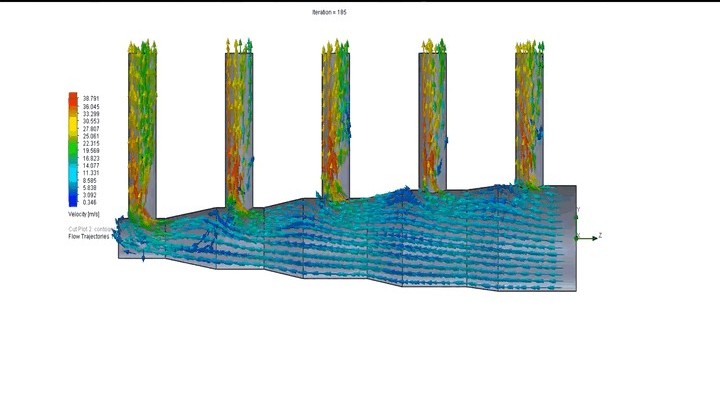
Hava ana hatta ilerler. Her dik çıkış bir pay alır. Renkler hızı, oklar akışın yönünü gösterir. Çıkışlara hava ayrıldıkça ana hatta kalan debi azalır, bu yüzden ana boru incelir.
Bağlantı süreklilik denklemidir. Debi, kesit alanı ile hızın çarpımıdır:
Q = A · v
Dairesel kanalın alanı:
A =π · D²4
Hızı seçip çapı bulmak için aynı denklem ters çevrilir:
D = √(4Q / (π · v))
Elinizde kütlesel debi varsa, önce havanın yoğunluğuyla hacimsel debiye geçilir:
Q =ṁρ
Hacimsel debi yazıldığında toplam için kütlesel debi ve yoğunluk kullanılmaz. Yoğunluk, çıkışları kg/h girdiğinizde yine gerekir.
Tablodaki iki çap
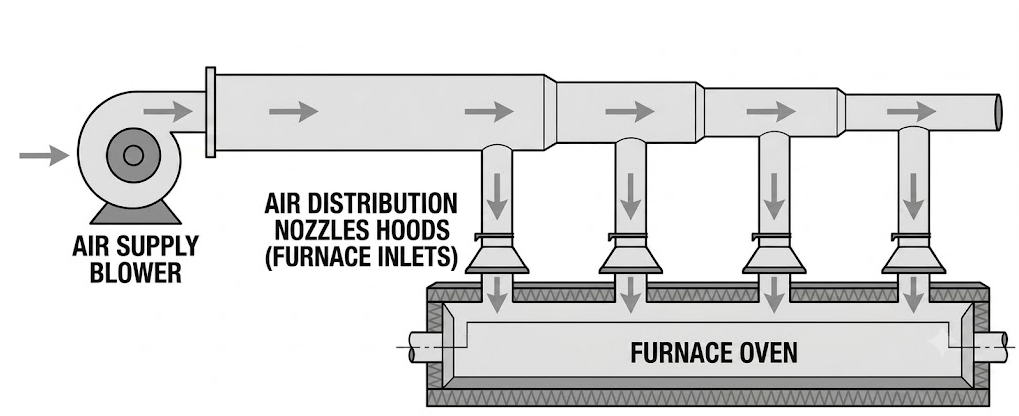
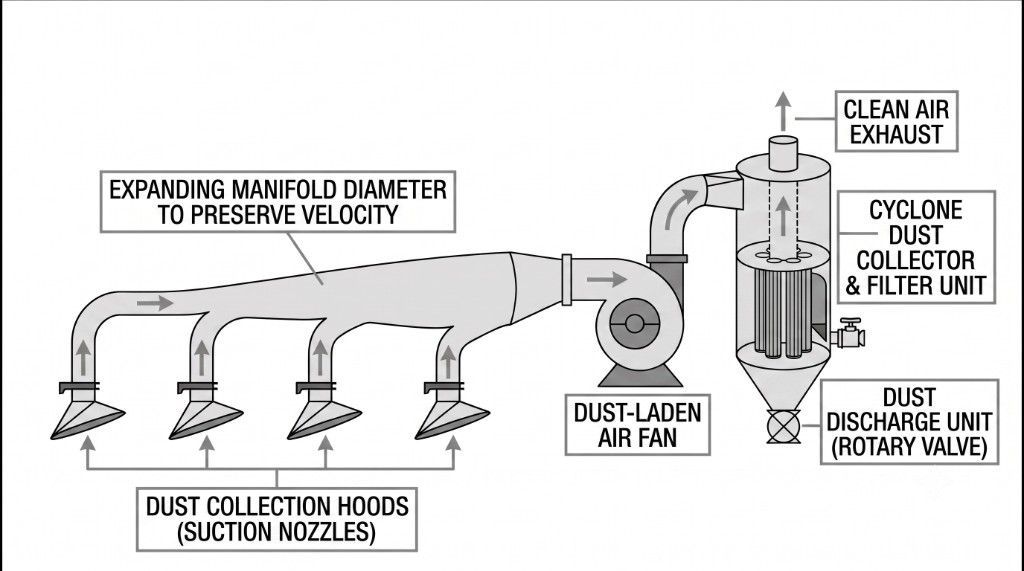
Hava basma. Fan soldadır. Her çıkıştan sonra ana boru incelir.Toz toplama. Davlumbazlardan gelen hava fana yaklaştıkça ana boruyu büyütür.
Ana boru fan çapı, havanın fana girdiği kesittir. Bu çap ve toplam debi, girişteki hızı verir. Tablo fandan itibaren ilerler. Bir çıkış debiyi alır. Branşman çapı, o çıkışın debisi ve istediğiniz çıkış hızıyla bulunur. Yeni ana boru çapı ise çıkış alındıktan sonra hatta kalan debi ve o segment için istediğiniz hızla bulunur. Aynı adım, yazdığınız çıkış sayısı kadar tekrarlanır.
Toz toplamada hat fana yaklaştıkça büyür. Bu sayfadaki sıra dağıtım şemasıdır: başlangıç fan tarafıdır, her çıkıştan sonra ana hat daralır.
Reklam
Örnek
Toplam debi 3.600 m³/h ve fan ağzı 500 mm olsun. Kesit alanı 0,1963 m², giriş hızı 5,09 m/s çıkar. İlk çıkış 1.000 m³/h, segment hızı 20 m/s ve çıkış hızı 25 m/s ise kalan debi 2.600 m³/h olur. Yeni ana çap 214,4 mm, branşman çapı 118,9 mm bulunur.
Bu hesap ön değerlendirme amaçlıdır. Dirsekler, pürüzlülük, sızdırmazlık ve fanın statik basıncı ayrıca bakılmalıdır. Sahada debi, damperle dengelenir. Nihai tasarım için yetkili bir mühendisin kontrolü gerekir.
Why equal velocity changes the duct diameter
In a duct that carries dust, chips or fume, particles settle once the speed falls below the conveying velocity. The equal velocity method has one job: keep the speed steady while the flow changes. Less flow means a smaller section. More flow means a larger one.
Air travels along the main. Each vertical outlet takes a share. Colour shows speed and the arrows show direction. As air leaves, less remains in the main, so the main gets smaller.
The link is the continuity equation. Flow is section area times velocity:
Q = A · v
The area of a round duct:
A =π · D²4
Turn the same equation around to find the diameter for a velocity you choose:
D = √(4Q / (π · v))
If you have a mass flow, convert it with the air density first:
Q =ṁρ
When a volumetric total is entered, mass flow and density are not used for that total. Density is still required when an outlet is entered in kg/h or lb/h.
The two diameters in the table
Air supply. The fan is on the left. The main gets smaller after each outlet.Dust collection. Air from the hoods makes the main larger as it approaches the fan.
The fan diameter is the section where the air enters the fan. That diameter and the total flow give the velocity at the inlet. The table walks away from the fan. An outlet takes its share of the flow. The branch diameter uses that outlet’s flow and the outlet velocity you want. The new main diameter uses the flow left in the duct and the segment velocity you want. The same step repeats for as many outlets as you enter.
A dust main grows as it approaches the fan. The order on this page is the supply layout: the start is the fan, and the main gets smaller after each outlet.
Reklam
Example
Take 3,600 m³/h and a 500 mm fan opening. The area is 0.1963 m² and the inlet velocity is 5.09 m/s. If the first outlet is 1,000 m³/h, with a segment velocity of 20 m/s and an outlet velocity of 25 m/s, 2,600 m³/h remains. The new main is 214.4 mm and the branch is 118.9 mm.
This calculation is for preliminary design. Elbows, roughness, leakage and the fan static pressure still have to be checked. Balance the flows with dampers on site. A qualified engineer should check the final design.